In the fall of 2024, a video stopped the internet.
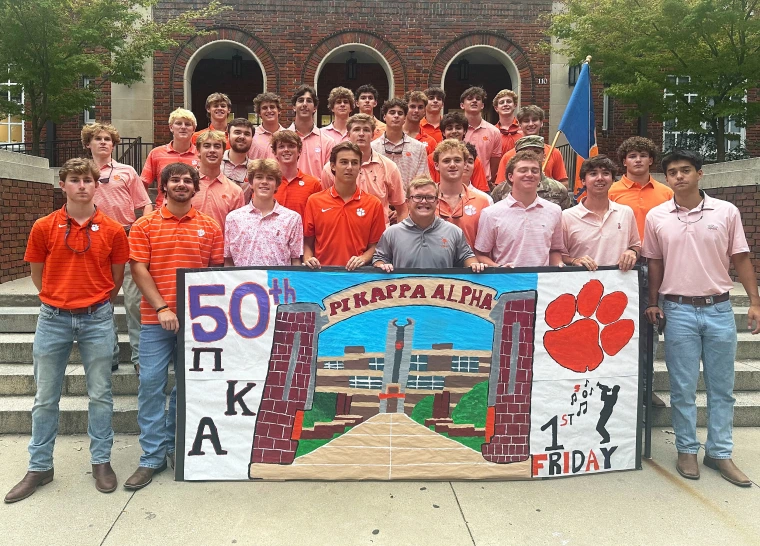
A young man named Charlie McGee — a junior at Clemson University with Down syndrome and a member of the ClemsonLIFE program — came running toward his new fraternity brothers the moment he accepted a bid from Pi Kappa Alpha. He was so overcome with joy that he ran right out of one of his shoes. His PIKE brothers surrounded him, jumping and cheering, in a scene that drew millions of views across social media and earned a feature on NBC’s TODAY “Morning Boost.”
What made the video so powerful was not the spectacle. It was the truth it revealed about what fraternity life is supposed to be — a place where young men are changed by each other, where brotherhood is extended not as a transaction but as a genuine act of character.
“Charlie brings the light to our chapter house,” said PIKE brother Zach Freeman. “He brought the happiness we didn’t know we were missing.”
What the world did not know then — what the cameras did not capture — was what Zach Freeman was going to do next.
Brotherhood as a Foundation, Leadership as the Next Step
When Zach Freeman ran for Student Body President at Clemson University in Spring 2025, he did not leave his fraternity experience at the door of the student government offices. He brought it with him.
Running alongside his vice presidential running mate Maya Khaskhely, Freeman made inclusion a central pillar of his campaign. Under the banner of “Enriching Campus Life,” their platform was explicit: fostering collaboration between ClemsonLIFE and the broader Clemson community to ensure every student — regardless of ability — had a place at the table.
They won.
And then they got to work.
Freeman’s administration created the Secretary of ClemsonLIFE Experience, a position embedded directly into the student government cabinet. It was the first role of its kind at Clemson — and possibly at any student government in the country. The position ensures that a ClemsonLIFE student has a permanent seat in the room where campus decisions are made: not as a symbolic gesture, but as a functioning member of university leadership.
Charlie McGee was selected as the first Secretary of ClemsonLIFE Experience.
He has since represented his peers at Clemson Day at the Statehouse in Columbia, South Carolina, engaging directly with state legislators, members of the Board of Visitors, and senior university administrators. He has collaborated with campus committees, brought forward new initiatives, and helped bridge gaps between the ClemsonLIFE community and the larger Clemson student body.
From bid day to the Statehouse. That is a fraternity story.
What Fraternity Life Actually Produces
The NIC’s ENGAGE initiative exists because the data has long pointed to a reality that critics of fraternity life rarely acknowledge: fraternity members are disproportionately likely to become campus leaders, public servants, and agents of institutional change.
According to NIC research, nearly half of fraternity members serve in other campus leadership roles — not just within their chapters. A Gallup survey commissioned by the NIC found that fraternity and sorority alumni are substantially more likely than their peers to report that their college education was worth the cost, to recommend their institution to others, and to donate back to their alma maters long after graduation. More than half of fraternity and sorority alumni had accepted a job offer within two months of graduation, compared to just 36 percent of non-affiliated alumni.
But numbers alone do not explain what happened at Clemson.
What happened at Clemson is what happens when the values of fraternity — brotherhood, character, service, leadership — are genuinely internalized by a young man and then carried into positions of public responsibility. Freeman did not create the Secretary of ClemsonLIFE Experience position because it polled well. He created it because his fraternity experience had already taught him that inclusion is not a program. It is a practice. And practices require structure.
This is precisely what the NIC’s ENGAGE initiative is designed to cultivate: fraternity and sorority members who run for office, who win, and who then use those positions to make their campuses — and eventually their communities — more just and more connected.
The Ripple That No One Filmed
One of the more remarkable details of the Clemson story is the ripple effect that followed the viral video.
After PIKE extended a bid to Charlie McGee in Fall 2024, six additional fraternities and five sororities at Clemson went on to welcome ClemsonLIFE students into their organizations. A single act of inclusion by one chapter became a community-wide shift in how Clemson’s fraternity and sorority life understood its own purpose.
That is the fraternity difference operating at full capacity.
NIC research shows that fraternity members report higher levels of interaction with people different from themselves than their non-affiliated peers — and that this engagement better prepares them to contribute to a diverse workforce and community. Freeman’s story is not an outlier. It is an illustration of what happens when those outcomes are lived out rather than simply listed on a fact sheet.
“He kind of broke all the preconceived notions that I thought of that a fraternity man should be like,” one PIKE brother said of Charlie.
That remark — honest, uncalculated, and directed inward — is one of the most compelling arguments for fraternity life that any researcher could hope to document. The experience changed the brother, not just the chapter. That is what high-impact membership looks like.
A Model Worth Replicating
The Secretary of ClemsonLIFE Experience is, at its core, a structural innovation born from a personal commitment. Freeman did not wait for someone else to create the position. He created it because he understood — from his chapter experience — that belonging is not self-sustaining. It has to be built into systems.
That instinct is what ENGAGE is designed to develop and to amplify.
Fraternity and sorority members currently hold student government positions on hundreds of campuses across North America. Each one of those positions is an opportunity to do what Freeman did: to take the values learned in a chapter house and translate them into policies, structures, and initiatives that outlast any single term of office.
The NIC tracks fraternity member participation in student government precisely because those positions matter. They are not resume lines. They are laboratories for the kind of leadership that moves from campus to statehouse to Congress — the pipeline that the fraternal movement has always represented, and that ENGAGE exists to strengthen.
Freeman will graduate. The Secretary of ClemsonLIFE Experience position will remain.
That is legacy. That is what fraternity produces when it is working as it should.
Zach Freeman is a member of Pi Kappa Alpha at Clemson University and served as Student Body President in 2025. Charlie McGee is a member of the ClemsonLIFE Program (Learning Is For Everyone) at Clemson University and served as the inaugural Secretary of ClemsonLIFE Experience in the Clemson Student Government cabinet.
ENGAGE is the NIC’s initiative supporting fraternity and sorority member participation in government, public policy, and student leadership. Learn more or share your leadership story at https://fraternalexcellence.org/engage.